


Innovation, immersive filming and new frontiers in live broadcasting
The Milano-Cortina 2026 Olympic Winter Games are not only a sporting event of global significance, but also an advanced laboratory for technologies that are transforming the way live events are covered.
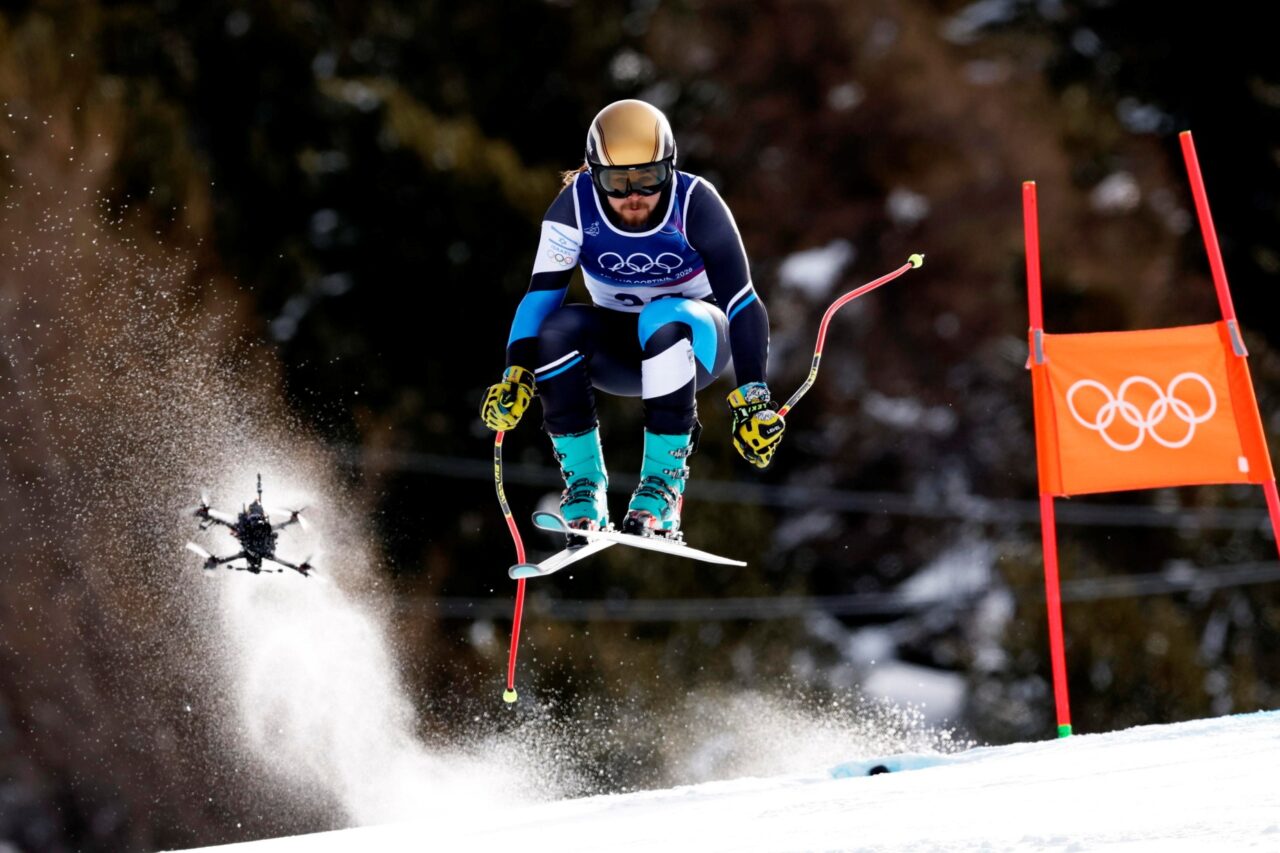
One of the most significant innovations is the use of FPV (First Person View) drones in television production. These are not just simple aerial shots: for the first time, the public will be able to follow the competitions through dynamic, immersive and real-time perspectives, thanks to actual “flying cameras” capable of moving within the race track.
What are FPV drones and why do they represent an evolution?
Unlike traditional drones, FPV systems are piloted using headsets that transmit real-time video footage from the on-board camera. The pilot therefore operates in first person, seeing exactly what the drone sees, as if they were on board the aircraft. This mode allows for continuous tracking along the race course, with a visual fluidity that is difficult to achieve with fixed cameras, suspended cables or ground vehicles.
For the 2026 edition, approximately 25 high-performance FPV drones are expected to be used, often customised or derived from racing and Cinewhoop platforms, capable of reaching speeds of close to 130 km/h. In disciplines characterised by high acceleration and complex trajectories, such as alpine skiing, snowboarding, bobsleigh and luge, this technology provides viewers with an extremely accurate perception of the dynamics of the race. The footage is not limited to documenting the event, but accompanies its development turn after turn, adapting in real time to the movements of the athletes.
The strategic role of FPV pilots
Behind these high-impact images lies not only technological innovation, but also a high level of human expertise.
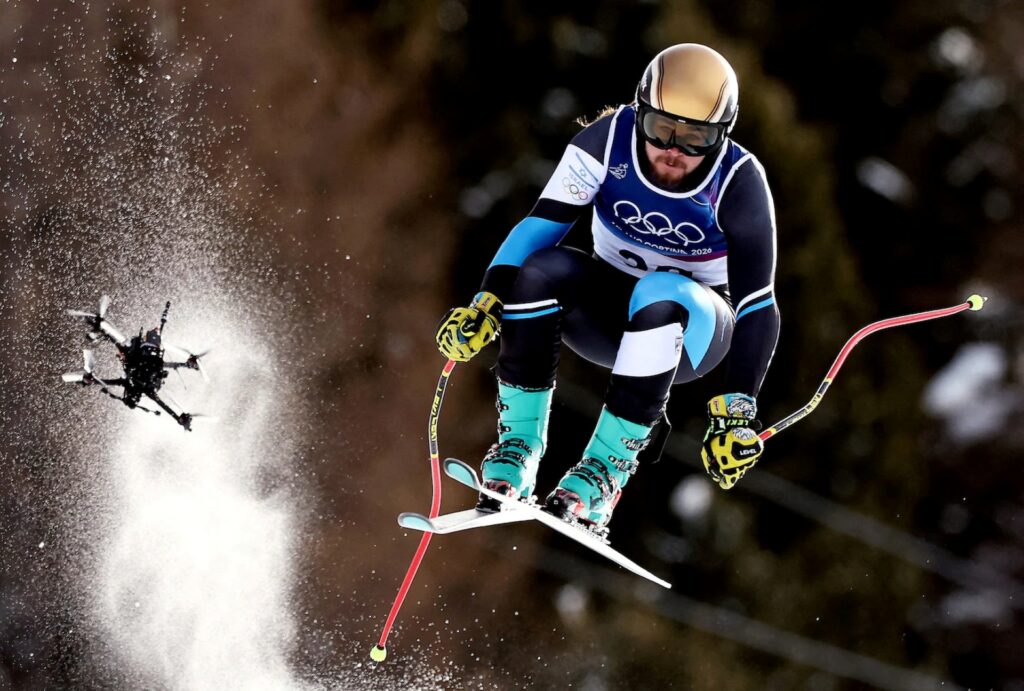
FPV pilots generally come from the world of drone racing and professional film-making. They are able to perform complex manoeuvres in critical environments, maintaining trajectories parallel to the athletes and reacting instantly to changes in speed, slope and route.
Operations take place in particularly challenging contexts: icy tracks, narrow channels, steep gradients and variable weather conditions. Piloting thus becomes a true technical performance, continuously coordinated with directors, video operators and production managers.
Radio frequency management: invisible infrastructure
Behind every spectacular shot lies a complex technological infrastructure, often invisible to the public but essential to the success of the event.
To ensure the simultaneous and correct functioning of security systems, timing, broadcast transmission, bodycams on athletes and video streams from drones, the Ministry of Enterprise and Made in Italy has authorised the use of approximately 8,000 dedicated radio frequencies.
This is a veritable digital network, designed to coordinate over 2,000 operators involved in the management of the Games, preventing interference and ensuring stable communications at every stage of the competition.
Operational safety and flight corridors
The use of FPV drones in a high-tech environment such as the Olympics requires rigorous airspace planning.
In Italy, all UAS operations are regulated by ENAC, which has defined specific temporary operational zones for Milan-Cortina 2026.
Within the competition areas, the following have been established:
- total no-fly zones
- authorised operational areas
- mandatory transit corridors
FPV pilots must keep their drones within virtual “tracks”, designed to:
- reduce the risk of collisions
- prevent radio interference
- ensure operational continuity
- avoid flying directly over athletes
This system combines high safety standards with maximum filming quality.
Configurations and developments
The introduction of FPV drones in filming the Milan-Cortina 2026 Winter Olympics marks a decisive step in the evolution of sports audiovisual language.
In highly complex technological contexts, value lies not only in the medium, but in the system that governs it: technical planning, radio integration and airspace management.
Milan-Cortina 2026 thus becomes a benchmark for live broadcasting and the professional use of drones. This is an approach that companies specialising in the UAS sector, such as SkySight, apply on a daily basis, adopting methodologies similar to those required for major international events.
Credits:
- Velocità, piloti e traiettorie: i droni stanno raccontando una nuova Olimpiade
- Milano-Cortina 2026: Droni FPV a 130 km/h e 8000 frequenze
- È il giorno delle Olimpiadi di Milano Cortina 2026, ecco tutte le tecnologie che vedremo per la prima volta
- “Che Spettacolo queste Riprese!” I droni FPV rubano la scena alle Olimpiadi Invernali di Milano Cortina
- Dietro le quinte dei droni alle Olimpiadi: come fanno i piloti a seguire tutti gli atleti